· A combination of multiple tracking algorithms enables tracking the maximum power point quickly and accurately
· Innovative Max Power Point Tracking(MPPT) technology, tracking efficiency >99.9%
· Full digital technology, high charge conversion efficiency up to 98%
· LCD display design, read operating data and working condition easily
· Real-time energy statistics function
· 12/24/48V automatic recognition
· Flexible System battery selection: Liquid, Gel, AGM and Lithium
· Extends battery life through accurate remote temperature sensor
· Controller is protected against over-temperature due to built-in power reduction function
· Four stages battery charging process: MPPT, boost, equalization, float
· Dual automatic protection to avoid exceeding the rated charging power and current
· Multiple load control modes: Always on, Street lamp, User-defind Mode
· Two USB interfaces(only -EU model)
· IoT wireless communication or Bluetooth communication functions optional
· With the wireless communication function of the IoT, the controller can be connected remotely through IoT/GPRS
· Monthly charging data can be calculated and displayed by grouping and graphs
· Based RS-485 standard Modbus protocol with RJ11 interface to maximize the communication needs of different occasions
· Perfect EMC & thermal design
· Full automatic electronic protect function for increased charge controller availability
Parameters:
Item | MT2010 | MT3010 | MT2075 | MT3075 | MT4010 | ||
Battery Parameters | Max Charging Current | 20A | 30A | 20A | 30A | 40A | |
System Voltage | 12V/24V automatical recognization | ||||||
Battery Type | Gel, AGM, Liquid, Lithium (default: Gel) | ||||||
Max volt on Bat. Terminal | 35V | ||||||
Gel, AGM, Liquid | MPPT Charging Voltage | before boost or equalization charging stage | |||||
Boost Voltage | 14.0~14.8V/28.0~29.6V @25℃(default:14.5/29V) | ||||||
Equalization Voltage | 14.0~15.0V/28.0~30.0V @25℃(default:14.8/29.6V) | ||||||
Float Voltage | 13.0~14.5V/26.0~29.0V @25℃(default:13.7/27.4V) | ||||||
Low voltage disconnect | 10.8~11.8V/21.6~23.6V, SOC1~5 (default: 11.2/22.4V) | ||||||
Low voltage reconnect | 11.4~12.8V/22.8~25.6V(default: 12.0/24.0V) | ||||||
Overcharge Protect | 15.8/31.3V | ||||||
Temp. Compensation | -4.17mV/K per cell (Boost, Equalization), -3.33mV/K per cell (Float) | ||||||
Lithium | Charging target voltage | 10.0~32.0V (Lithium, default: 14.4V) | |||||
Charging recovery voltage | 9.2~31.8V (Lithium, default: 14.0V) | ||||||
Low voltage disconnect | 9.0~30.0V (Lithium, default: 10.6V) | ||||||
Low voltage reconnect | 9.6~31.0V (Lithium, default: 12.0V) | ||||||
Panel Parameters | Max volt on PV terminal *1 | 95V | 55V | 95V | |||
Max input power | 260/520W | 390/780W | 260/520W | 390/780W | 520/1040W | ||
Day/Night threshold | 3.0~20.0V(default: 8.0/16.0V) | ||||||
Day/Night delay time | 0~30min(default: 0min) | ||||||
MPPT tracking range*2 | (Battery Voltage + 1.0V)~Voc*0.9 | ||||||
Load Parameters | Output Current | 20A | 30A | 20A | 30A | ||
Load mode | Always on, Street lamp, User-defind Mode | ||||||
System Parameters | Max tracking efficiency | >99.9% | |||||
Max charge conversion | 98.0% | ||||||
Dimensions(mm) | 189*182*64mm | 189*255*63mm | 189*182*58mm | 189*182*64mm | 189*255*69mm | ||
Weight | 1Kg | 1.5Kg | 1Kg | 1.3Kg | 2Kg | ||
Self consumption | ≤8mA(12V),≤12mA(24V) | ||||||
Communication | RS485(RJ11 interface) | ||||||
Optional | IoT, Cyber-BT (Internal / External) | ||||||
Grounding | Common Negative | ||||||
Power terminals | 6AWG (16mm2) | ||||||
Ambient temperature | -20~+55℃ | ||||||
Storage temperature | -25~+80℃ | ||||||
Ambient humidity | 0~100%RH | ||||||
Protection degree | IP32 | ||||||
Max Altitude | 4000m | ||||||
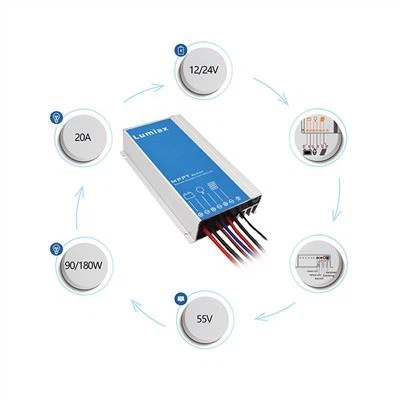
MT2075 is a sort of 20amp MPPT Solar charge Controller.
It is fit for 12V/24V automatic recognition as well as 20A charge and discharge current.
A solar charge controller controls the power from PV go to the battery. It protects deep cycle batteries from overcharged during the day, and prohibits the power run back to the PV at night and drain the batteries. Some charge controllers add some additional functions, like lighting and load control, but its primary job is protecting batteries.
There are two different technologies for a solar charge controller-PWM and MPPT. How they work and perform in a system is very different from each other. An MPPT charge controller is more expensive than a PWM charge controller, but it is often worth it to pay the extra money.
 |  |
Hot Tags: 20amp mppt solar charge controller, China 20amp mppt solar charge controller manufacturers, waterproof mppt solar charge controller, long lifespan mppt solar charge controller, compelling product, in demand product, captivating merchandise, solar charge controller for camper